Blog Audio for Publishers 10 November 2026 6 min read
German voices,
made in Germany.
SONA is now in BotTalk.
About three quarters of the audio we produce at BotTalk is German. So when a team in Potsdam, with roots at the Fraunhofer institute where mp3 comes from, builds a voice engine, we want you to be able to use it. The engine is called SONA, and it is now one of the voices in BotTalk.
When you set up a project in BotTalk, you choose a language and then a voice. If your language is German, there is a new name in that second list.
We want to tell you who built it, what you can set, and what we cannot tell you yet.
Why German text-to-speech is our main job
Most of what BotTalk reads aloud is German. Between September 2025 and August 2026 about 75% of the audio we produced was German.[5]
The big voice models are built for many languages, and on German news text they still slip in ways your listeners hear immediately. An English sound creeps into a German name. A year comes out as a different year. Once in a while a voice starts to sing in the middle of a sentence.
Our control layer exists to catch those mistakes before your listeners hear them, and it works above every engine we connect. It holds 21,900 pronunciation rules across 15,900 dictionaries, it rewrites numbers and abbreviations the way they are spoken before the text reaches an engine, and it checks for the moments when a model makes something up.
That layer has less to do when the engine underneath already speaks good German. To our ears SONA does, and that is why it is in BotTalk. It sits next to ElevenLabs, Gemini, OpenAI, Azure and Amazon Polly under the same layer. You choose the voice for each project, and you can swap it whenever you like.
Who built SONA
SONA is made by SONALAB GmbH in Potsdam.[2] The company is part of the MediaTech Hub Potsdam, which sits in Babelsberg right next to the film studios.[1] Its two founders come at the same problem from two sides. Alexander Wolf comes from sound and sound design, with Bavaria Film and ZDF among his stations. Sören Hübner, the CTO, brings the software and the machine learning.[1][6]
The company grew out of a research partnership with the Fraunhofer Institute for Integrated Circuits IIS, and it calls itself a Fraunhofer spin-off.[1] If the institute’s name does not ring a bell, its best-known work will. The mp3 format comes from there. In 1987 the institute formed a research alliance with the University of Erlangen-Nuremberg for it, and in 1995 the researchers voted on the file extension themselves.[3] When we say German engineering, this is the tradition we mean.
SONA was built for dubbing and post-production studios, and its plugin works inside Pro Tools, Nuendo and Premiere.[2] In a studio a generated line has to sit in a film mix next to lines that actors recorded, and the people who judge it listen for a living. That is a hard audience to convince.
We also like how the founders talk about their work. In an interview in July they said: “We do not promise that machines sound better than people. We would rather show concretely what works and leave the verdict to the studios.”[1] The interview is in German and the translation is ours. It is how we want to work with newsrooms, too.
What you can set
In the settings of a project, under Audio, you choose German as the language and then the SONA voice in the list beside it. In our screenshot that voice is Elin, listed as de-DE-Elin-SONA. Under the list you see a star and the line “Premium voices are the highest quality on BotTalk”. The star marks our premium voices, and SONA is one of them. Preview plays the voice.
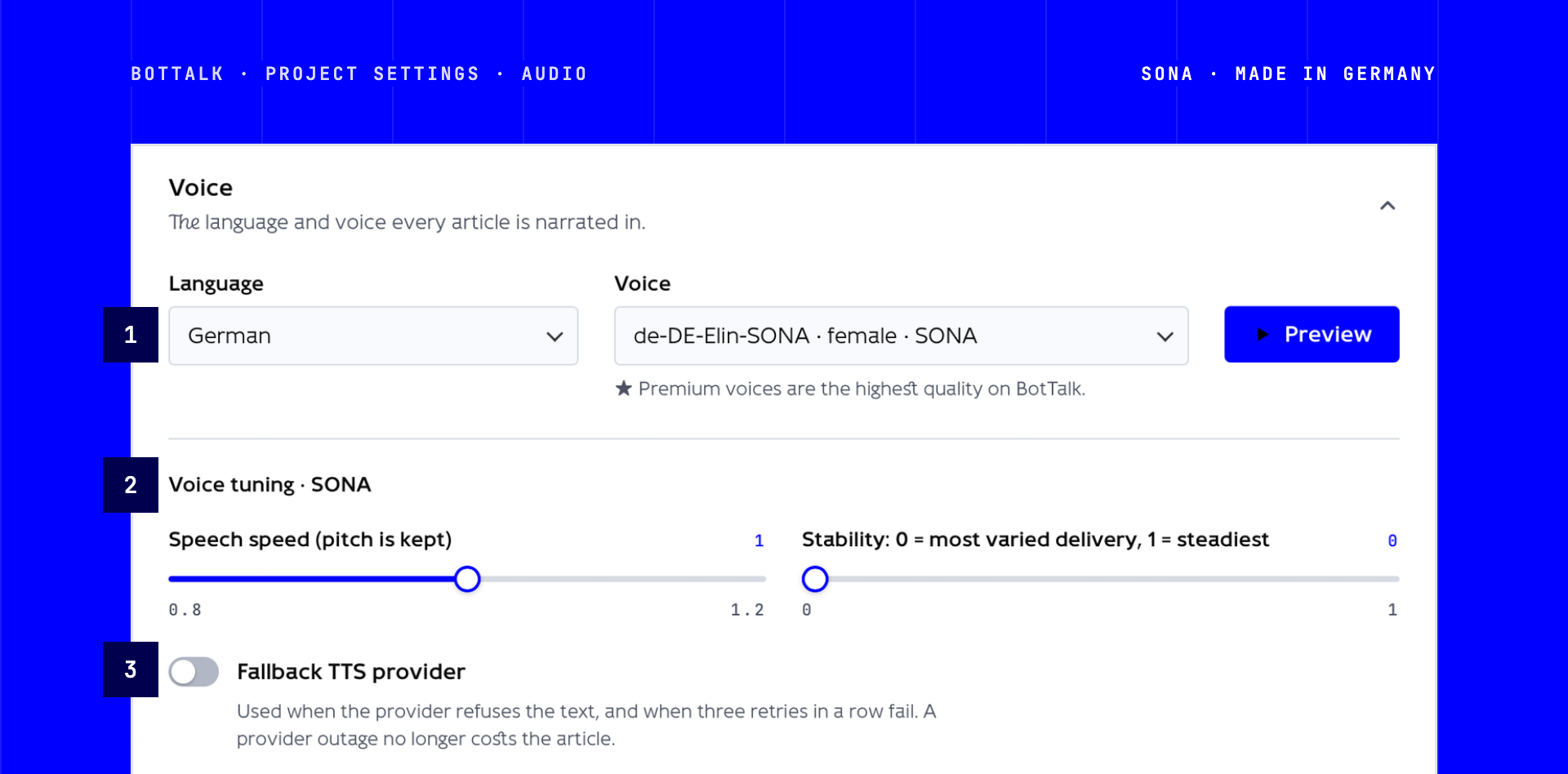
- Choose German as the language and the SONA voice next to it. The star marks a premium voice, and Preview plays it.
- Speech speed runs from 0.8 to 1.2 and keeps the pitch. Stability runs from 0, the most varied delivery, to 1, the steadiest.
- The fallback provider takes over when the first one refuses a text, and when three retries in a row fail.
Two controls under the voice belong to SONA. Speech speed runs from 0.8 to 1.2, and the pitch is kept, so a faster read does not turn into a higher voice. Stability runs from 0 to 1. At 0 the delivery varies the most, and at 1 it is the steadiest.
One more switch sits on the same card, and we want you to know it is there. It is called Fallback TTS provider. BotTalk uses it when a provider refuses a text, and when three retries in a row fail, so that an outage at one provider no longer costs you the article.
A voice from Germany, for readers in Germany
Elin is listed as de-DE, which is German as it is spoken in Germany. That matters more than it sounds, because listeners hear where a voice comes from. When heute.at in Vienna looked for its voice, an earlier evaluation of AWS Polly failed on the accent alone. The CTO, Alexander Ottitzky, gave us the sentence we still quote.

“Pick a voice from Paderborn, and the readers walk.”

We take that sentence seriously in both directions. For readers in Germany, a voice built in Germany is the right place to start. For readers in Vienna or Zurich, Elin would be the voice from Paderborn, and we would choose a different one with you. You set the voice for each project, so one publisher can run both.
Made in Germany, in practice
Made in Germany is easy to print on a box, so here is what stands behind it in this case. SONALAB is a German company with its seat in Potsdam. It says its platform is built, hosted and processed on EU infrastructure, that its servers run in Germany, and that uploads, processing and renders never leave that infrastructure.[2] BotTalk runs on infrastructure in Germany as well.
Then there is a question we expect every newsroom to be asked sooner or later: can you show where this audio came from? SONALAB’s answer on its own platform is a tool called SONA Verify. You drop a file into it and see whether it came from SONA, which voices were used and who owns it. The company says it is building the tool to survive cuts and re-encoding into formats such as mp3. When a voice artist joins, the consent is recorded in the same step as the voice.[2] In the founders’ words, consent and traceability are built in from the start and not bolted on afterwards.[1]
The law is moving in the same direction. Article 50 of the EU AI Act asks providers of systems that generate synthetic audio to mark their output in a machine-readable way.[4]
What we cannot tell you yet
We want to be straight with you about the limits. For the engines we have run for years we can show you an error rate with its denominator. For SONA we cannot yet, because it is new in BotTalk. We also will not tell you it is the best German voice on the market, because we have no measurement that proves it. We can show you who built it, where it runs and what you can set. The rest you can judge with your own ears, which is what SONA’s founders ask of their studios, too.
Hear it on your own articles
The quickest way to judge a voice is to hear it read something you published. Write to Andrey at andrey@bottalk.io and send three articles with the names and numbers your current voice gets wrong. We will play them back to you in SONA’s voice and in the voice you use today, and you decide by ear.
Frequently asked
What publishers ask us about SONA.
What is SONA?
SONA is a voice AI made by SONALAB GmbH in Potsdam, Germany. The company grew out of a research partnership with Fraunhofer IIS, describes itself as a Fraunhofer spin-off and builds its product for dubbing and post-production studios. In BotTalk, SONA is one of the voice engines that can narrate your articles.
Is SONA made in Germany?
SONALAB is a German company based in Potsdam. It states that its platform is built, hosted and processed on EU infrastructure, that its servers run in Germany, and that uploads, processing and renders never leave that infrastructure.
Which SONA voice can I use in BotTalk?
The voice in our settings is Elin, a female German voice listed as de-DE-Elin-SONA. If you need another voice, or German for readers in Austria or Switzerland, ask us and we will tell you what is available.
Can I change how the SONA voice reads?
Yes. Speech speed runs from 0.8 to 1.2 with the pitch kept, and stability runs from 0 for the most varied delivery to 1 for the steadiest. You set both in the project settings under Audio.
What happens when SONA fails on an article?
You can switch on a fallback TTS provider on the same settings card. BotTalk then uses a voice from another provider when the first one refuses a text, and when three retries in a row fail.
Does SONA replace the other voice engines in BotTalk?
No. SONA joins ElevenLabs, Gemini, OpenAI, Azure and Amazon Polly under the same control layer. You choose the voice for each project and you can swap it at any time.
Sources
What each claim rests on.
-
Interview with Alexander Wolf and Sören Hübner, SONALAB: Verändert KI die Zukunft der Synchronisation dauerhaft? The source for the research partnership with Fraunhofer IIS, the Fraunhofer spin-off, the founders’ backgrounds, the MediaTech Hub Potsdam and the quoted sentence. The interview is in German and the translations are ours.
startupvalley.news ↗ -
SONALAB’s own pages (How it works, Help, Legal notice), checked on 10 November 2026: the seat in Potsdam, the plugin hosts, EU data residency and servers in Germany, SONA Verify and consent. These are the company’s own statements about its own platform.
sonalab.eu/how-it-works ↗ -
The institute’s own timeline: the research alliance with the University of Erlangen-Nuremberg in 1987, and the internal poll in 1995 in which the researchers chose .mp3 as the file extension.
mp3-history.com ↗ -
Regulation (EU) 2024/1689, Article 50, paragraph 2: providers of AI systems that generate synthetic audio make sure the output is marked in a machine-readable format and can be detected as artificially generated.
artificialintelligenceact.eu ↗ -
From BotTalk’s own systems, September 2025 to August 2026: about 75% of the audio generated was German. The 21,900 pronunciation rules across 15,900 dictionaries are the count in production. Both are our own numbers and carry no independent verification.
Published in our ReadSpeaker comparison → -
Speaker page of the 13th Media Web Symposium: Sören Hübner, Co-Founder and CTO of SONALAB GmbH.
mws.fraunhofer.de ↗